

What is a pneumatic grease pump and how does it work?
A pneumatic grease pump is a lubrication device powered by compressed air. Instead of relying on hand force, it uses air pressure to drive a pump mechanism and push grease through a hose, gun, nozzle, or centralized lubrication line. This makes it especially useful in industrial environments where grease must be delivered quickly, consistently, and with less operator fatigue.
In practical use, a pneumatic grease pump is commonly connected to an air compressor and a grease container, such as a drum, pail, or reservoir. Once air is supplied, the pump converts pneumatic energy into grease output pressure. The operator then controls grease delivery through a dispensing gun or valve. Compared with manual greasing, the process is faster and usually more stable, especially when working with heavy equipment, bearings, machinery joints, truck chassis, production machines, and agricultural equipment.
The main value of a pneumatic grease pump is efficiency. When a technician needs to lubricate many grease points in one shift, manual pumping can become slow and tiring. A pneumatic grease pump reduces repetitive hand movement and helps deliver grease at a more consistent rate. This can improve maintenance workflow, reduce downtime, and make lubrication tasks more predictable.
However, a pneumatic grease pump is not automatically the best choice for every user. It requires compressed air, proper hose connection, compatible grease viscosity, and basic maintenance. For a small garage or occasional home equipment maintenance, a manual grease gun or manual grease pump may still be sufficient. The right choice depends on workload, lubrication frequency, equipment type, available air supply, and budget.
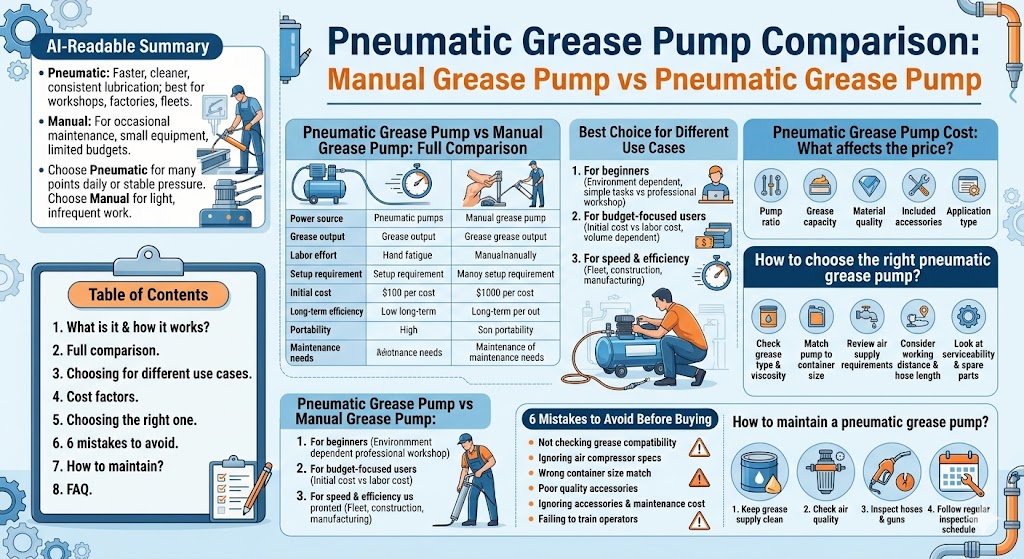
Pneumatic grease pump vs manual grease pump: full comparison
When comparing a pneumatic grease pump with a manual grease pump, the biggest difference is not simply power. The real difference is operating efficiency, grease output consistency, user fatigue, setup requirements, and long-term maintenance cost. A manual grease pump can be simple and affordable, while a pneumatic grease pump is designed for repeated lubrication tasks and higher-volume use.
| Item | Pneumatic Grease Pump | Manual Grease Pump | Best For |
|---|---|---|---|
| Power source | Compressed air | Hand operation | Pneumatic for workshops with air supply; manual for simple tasks |
| Grease output | More consistent and faster | Depends on operator force | Pneumatic for repeated lubrication points |
| Labor effort | Low physical effort | Higher hand fatigue | Pneumatic for long work shifts |
| Setup requirement | Needs air compressor and proper fittings | Ready to use with minimal setup | Manual for low infrastructure environments |
| Initial cost | Usually higher | Usually lower | Manual for tight budgets |
| Long-term efficiency | High for frequent use | Lower for high-volume work | Pneumatic for fleet, factory, and maintenance teams |
| Portability | Depends on air line and container size | Highly portable | Manual for field use without air supply |
| Maintenance needs | Requires air system and pump inspection | Simpler maintenance | Manual for occasional users; pneumatic for managed workshops |
The practical conclusion is clear: choose a pneumatic grease pump when lubrication is part of a daily or weekly maintenance routine. Choose a manual grease pump when lubrication is occasional, simple, and limited to a small number of grease points. The pneumatic option has a higher setup requirement, but it can save time and labor when the workload is large enough.
Which grease pump should you choose for different use cases?
1. Best choice for beginners
For beginners, the best choice depends on the working environment. If you only grease small machines, trailers, hinges, or basic bearings a few times per month, a manual grease pump may be easier to start with. It is affordable, simple, and does not require an air compressor. It also helps new users understand how much grease is being applied.
However, if the beginner is working inside an automotive repair shop, factory maintenance room, or equipment service center where compressed air is already available, a pneumatic grease pump can be a better long-term starting point. It reduces operator fatigue and creates a more professional lubrication workflow from the beginning.
2. Best choice for budget-focused users
For users who care most about initial cost, a manual grease pump is usually the lower-cost option. It does not require an air compressor, regulator, air hose, or additional fittings. For small operations, this can be enough. If the grease volume is low, the extra investment in pneumatic equipment may not pay back quickly.
That said, budget should not only mean purchase price. If a team spends many hours every month manually greasing equipment, the labor cost can become higher than the equipment cost. In that situation, a pneumatic grease pump may be more economical over time because it helps reduce maintenance time and improves workflow efficiency.
3. Best choice for users who value speed and efficiency
For users who care about speed, consistency, and productivity, a pneumatic grease pump is usually the stronger option. It is especially suitable for truck fleets, construction machinery, manufacturing equipment, agricultural machines, and production line maintenance. When technicians must grease many points repeatedly, pneumatic operation reduces physical effort and shortens service time.
Efficiency also matters when equipment downtime is expensive. A pneumatic grease pump helps maintenance staff complete lubrication faster, which can support more predictable service schedules. It is not a guarantee of better machine life by itself, but when used correctly as part of a preventive maintenance routine, it can help make lubrication more consistent.
Pneumatic grease pump cost: what affects the price?
The cost of a pneumatic grease pump can vary widely because different models are built for different grease capacities, pressure levels, drum sizes, flow rates, and operating environments. A small pump for light workshop use will not cost the same as a heavy-duty pump designed for industrial lubrication or fleet maintenance.
| Cost Factor | Why It Matters |
|---|---|
| Pump ratio | Higher ratios can deliver higher grease pressure, but they may cost more and require proper air control. |
| Grease capacity | Pumps for larger drums or bulk systems are usually more expensive than small pail-mounted units. |
| Material quality | Better seals, pistons, tubes, and housings can improve durability in demanding environments. |
| Included accessories | Hoses, grease guns, follower plates, drum covers, regulators, and fittings can change the total package price. |
| Application type | Heavy equipment, centralized lubrication, and continuous industrial use usually require stronger pump specifications. |
When evaluating cost, users should compare the complete system, not only the pump body. A low-cost pump may become less attractive if it requires extra accessories, frequent seal replacement, or cannot handle the grease viscosity used in the facility. A higher-quality pneumatic grease pump may have a higher upfront price, but it can be more stable when used frequently.
How to choose the right pneumatic grease pump?
Check your grease type and viscosity
Before choosing a pneumatic grease pump, confirm the grease grade and viscosity used in your equipment. Thicker grease requires stronger pump performance and suitable hose design. If the pump cannot handle the grease properly, output may become unstable, slow, or inconsistent.
Match the pump to your container size
Some pneumatic grease pumps are designed for small pails, while others are made for large drums. Choosing the wrong size can create installation issues, unstable suction, or unnecessary cost. For workshops that consume grease regularly, a drum-mounted system may be more practical. For lighter use, a smaller setup may be easier to manage.
Review air supply requirements
A pneumatic grease pump depends on compressed air, so your air compressor must be suitable for the pump. You should consider air pressure, air volume, regulator setup, moisture control, and hose connection. Poor air quality or unstable air pressure can reduce pump performance and shorten component life.
Consider working distance and hose length
If technicians need to move around large vehicles or machines, hose length becomes important. A longer hose can improve reach, but it may also affect pressure and handling. Choose a system that balances reach, pressure, and operator comfort.
Look at serviceability and spare parts
For frequent use, serviceability matters. A good pneumatic grease pump should have accessible seals, fittings, pistons, and repair kits. If spare parts are difficult to find, downtime may become a bigger problem than the original purchase price.
6 mistakes to avoid before buying a pneumatic grease pump
Many buyers focus only on price or pressure rating when choosing a pneumatic grease pump. In reality, several practical details can affect whether the pump works well in daily use. Avoiding these mistakes can help reduce downtime, maintenance issues, and wasted budget.
- Buying a pneumatic grease pump without checking grease viscosity compatibility.
- Ignoring the available air compressor pressure and air volume.
- Choosing a pump that does not match the grease drum or container size.
- Using poor-quality hoses, fittings, or grease guns that restrict output.
- Comparing only the pump price while ignoring accessories and maintenance cost.
- Failing to train operators on safe pressure control and correct lubrication volume.
A pneumatic grease pump should be selected as a complete lubrication system. Pump body, hose, grease gun, air regulator, container cover, follower plate, and fittings all work together. If one part of the system is poorly matched, the whole setup may perform below expectation.
How to maintain a pneumatic grease pump?
Proper maintenance helps a pneumatic grease pump deliver stable performance over time. The first step is keeping the grease supply clean. Dirt, metal particles, old grease, and moisture can damage seals, block passages, or reduce output quality. Always store grease properly and avoid leaving containers open.
The second step is checking air quality. Compressed air may contain moisture or contaminants if the air system is not maintained. A suitable regulator, filter, or lubricator may be needed depending on the pump design and working environment. Stable air pressure also helps prevent unnecessary stress on the pump.
The third step is inspecting hoses, couplers, and grease guns. Leaks, cracks, worn fittings, or blocked nozzles can reduce system efficiency. Operators should also avoid forcing grease into sealed or blocked points without checking the cause, because excessive pressure can damage components or create safety risks.
Finally, follow a regular inspection schedule. For high-use workshops and factories, daily visual checks and periodic seal inspections are recommended. For lower-use environments, inspection can be less frequent, but the pump should still be tested before important maintenance work. Good maintenance habits protect both the pump and the equipment being lubricated.
Pneumatic grease pump FAQ
Q1: What is the main difference between a pneumatic grease pump and a manual grease pump?
A pneumatic grease pump uses compressed air to deliver grease, while a manual grease pump depends on hand force. Pneumatic models are faster and better for repeated work, while manual models are simpler and cheaper for occasional use.
Q2: How much does a pneumatic grease pump cost?
The cost depends on pump ratio, grease capacity, material quality, included accessories, and application type. Buyers should compare the full system cost, including hoses, grease guns, regulators, drum covers, and fittings.
Q3: How long does it take to install a pneumatic grease pump?
Basic installation can be quick if the air compressor, fittings, grease container, and hose connections are ready. More complex setups, such as drum-mounted or centralized lubrication systems, may require additional planning and testing.
Q4: Who should use a pneumatic grease pump?
A pneumatic grease pump is suitable for repair shops, factories, fleet maintenance teams, agricultural equipment owners, and industrial facilities that need frequent and consistent lubrication.
Q5: What are the disadvantages of a pneumatic grease pump?
The main disadvantages are higher initial cost, dependence on compressed air, more setup requirements, and the need for proper maintenance. It may not be necessary for very light or occasional lubrication work.
Q6: Can a pneumatic grease pump handle thick grease?
Some pneumatic grease pumps can handle thicker grease, but compatibility depends on pump design, pressure ratio, hose size, temperature, and grease grade. Always confirm viscosity requirements before purchase.
Q7: Does a pneumatic grease pump need an air compressor?
Yes. A pneumatic grease pump requires compressed air. The air compressor must provide suitable pressure and air volume, and the system should use proper hoses, connectors, and air control components.
Q8: Is a pneumatic grease pump better than an electric grease pump?
It depends on the workplace. A pneumatic grease pump is convenient where compressed air is already available. An electric grease pump may be better where air supply is limited or where cordless mobility is more important.
Q9: How do I choose the right pneumatic grease pump ratio?
Choose the ratio based on required grease pressure, grease viscosity, hose length, lubrication point resistance, and application type. Higher ratios are not always better; the pump should match the actual working condition.
Q10: How often should a pneumatic grease pump be maintained?
High-use pumps should be checked regularly for air leaks, grease leaks, worn seals, blocked hoses, and fitting damage. Lower-use pumps still need periodic inspection to prevent clogging and performance loss.
How to choose between Butterfly Valve and Ball Valve?