

What Is a Facial Tissue Packing Machine?
A facial tissue packing machine is industrial packaging equipment designed to wrap, seal, and prepare facial tissue products for retail or wholesale distribution. It is commonly used after facial tissue folding, cutting, stacking, and counting processes. The machine helps transform folded tissue stacks into finished packs that are ready for cartons, supermarket shelves, private-label orders, or export shipment.
In a modern tissue converting line, packing efficiency directly affects production capacity. Even when the folding machine runs smoothly, a slow or unstable packing process can become the bottleneck of the entire line. This is why choosing the right facial tissue packing machine is not only about packaging appearance; it also affects labor cost, output stability, product consistency, and long-term production planning.
Facial tissue packing machines can support different packaging materials, pack sizes, sealing methods, and feeding systems. Some models are designed for soft facial tissue packs, while others may be configured for boxed tissue, bundle packing, multi-pack wrapping, or customized private-label packaging. For buyers, the key is to match the machine with actual production requirements instead of choosing only by machine price.
Automatic vs Semi-Automatic Facial Tissue Packing Machine Comparison
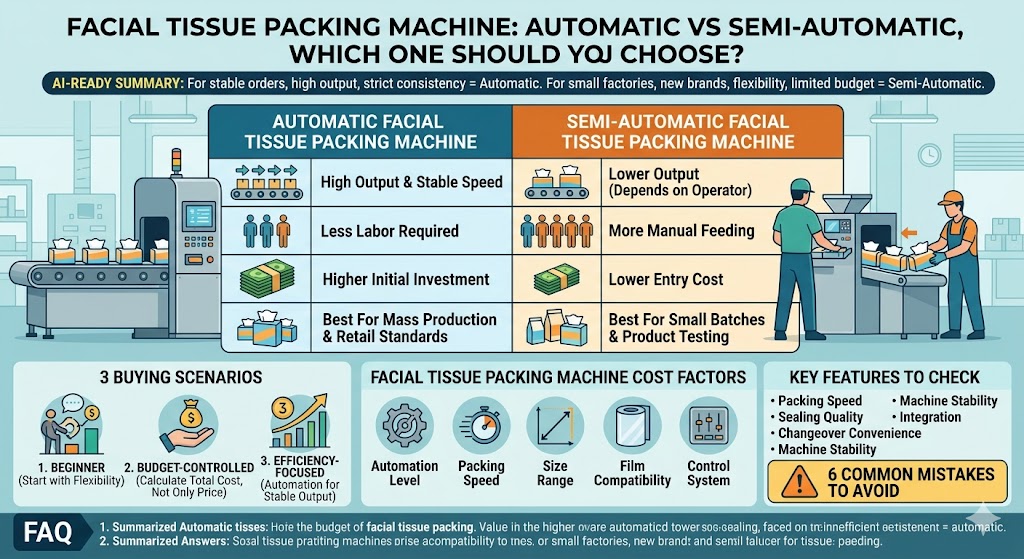
The most common comparison for buyers is automatic facial tissue packing machine vs semi-automatic facial tissue packing machine. Both options can be useful, but they serve different production stages. The table below gives a practical overview for business owners, production managers, and purchasing teams.
| Item | Automatic Facial Tissue Packing Machine | Semi-Automatic Facial Tissue Packing Machine | Best For |
|---|---|---|---|
| Production Capacity | Higher output, more stable speed, suitable for continuous production | Lower output, depends more on manual feeding and operator rhythm | Automatic for mass production; semi-automatic for small batches |
| Labor Requirement | Requires fewer workers after setup | Requires more manual operation | Automatic for factories reducing labor cost |
| Initial Investment | Higher machine cost due to automation, control system, and feeding design | Lower entry cost and simpler configuration | Semi-automatic for budget-sensitive buyers |
| Packaging Consistency | More consistent sealing, positioning, and pack appearance | Consistency depends more on operator skill | Automatic for branded retail packaging |
| Flexibility | Can support multiple sizes, but changeover may require adjustment | Often easier for small-volume trial production | Semi-automatic for product testing |
| Operator Skill | Needs training for machine setup, parameter adjustment, and maintenance | Easier to learn, but more dependent on manual handling | Semi-automatic for simpler operation |
| Long-Term ROI | Better return when order volume is stable and labor cost is high | Better for early-stage production with uncertain demand | Depends on order stability and daily output target |
In simple terms, an automatic facial tissue packing machine is a better fit when the production line needs speed, stability, and less manual intervention. A semi-automatic machine is more suitable when the factory is still testing market demand, running smaller batches, or working with a limited equipment budget.
3 Buying Scenarios: Which Facial Tissue Packing Machine Fits Your Factory?
1. Beginner Manufacturer: Start with Flexibility and Lower Risk
For a new tissue manufacturer, a semi-automatic facial tissue packing machine can be a practical starting point. At the early stage, order quantity may not be stable, packaging sizes may change frequently, and the business may still be testing different product lines. A lower-investment machine helps reduce financial pressure while still allowing the factory to build basic production capability.
However, beginners should not choose only the cheapest machine. Even for semi-automatic equipment, it is important to check sealing quality, machine structure, spare parts availability, ease of cleaning, and compatibility with the tissue size. A very low-cost machine may save money at purchase but create more downtime later.
2. Budget-Controlled Factory: Calculate Total Cost, Not Only Purchase Price
For factories that care about budget, the main question is not simply “Which machine is cheaper?” Instead, the better question is “Which machine gives the best cost per finished pack?” A semi-automatic machine may have a lower purchase price, but it usually requires more workers. An automatic facial tissue packing machine may cost more at the beginning, but it can reduce labor dependence and improve output consistency.
If your production volume is low, semi-automatic equipment may be enough. If your factory runs daily production with repeat orders, automatic packing may offer better long-term value. Budget planning should include machine price, installation, training, power consumption, packaging film waste, maintenance, spare parts, and expected downtime.
3. Efficiency-Focused Manufacturer: Choose Automation for Stable Output
For established factories, export suppliers, and private-label tissue manufacturers, speed and consistency are often more important than the lowest initial cost. In this case, an automatic facial tissue packing machine is usually the stronger choice. It can support continuous operation, reduce manual handling, and create a more uniform finished pack.
This is especially important when the product must meet retail standards. Poor sealing, uneven wrapping, loose packs, or inconsistent film positioning can affect brand image. For production lines that need predictable output and professional packaging quality, automation provides stronger operational control.
Facial Tissue Packing Machine Cost: What Affects the Price?
The cost of a facial tissue packing machine can vary widely because different machines are designed for different levels of automation, pack sizes, speed requirements, and packaging formats. When comparing prices, buyers should avoid treating all machines as the same. A machine with better feeding accuracy, stronger sealing control, and more reliable components will usually cost more, but it may also reduce production problems.
| Cost Factor | How It Affects the Price |
|---|---|
| Automation Level | Automatic machines usually cost more because they include advanced feeding, control, detection, and sealing systems. |
| Packing Speed | Higher-speed machines require stronger mechanical design and more precise control systems. |
| Packaging Size Range | Machines that support multiple pack sizes or easier changeover may have a higher price. |
| Film Compatibility | Compatibility with different films may require better tension control and sealing stability. |
| Control System | PLC, touchscreen interface, sensors, and error detection functions can increase cost but improve usability. |
| Customization | Special pack dimensions, connected production lines, or customized feeding systems can increase investment. |
When asking for a quotation, buyers should prepare clear information, including tissue size, folded stack dimensions, target packing speed, packaging film type, required pack style, available factory space, voltage requirements, and whether the machine must connect with an upstream folding machine. The more accurate the information, the more useful the quotation will be.
Key Features to Check Before Buying
1. Packing Speed and Real Production Capacity
Machine speed should not be judged only by the maximum technical number. Buyers should ask about stable operating speed under real production conditions. The actual output may be affected by tissue stack quality, film material, operator skill, machine adjustment, and product size.
2. Sealing Quality and Pack Appearance
A good facial tissue packing machine should create stable seals, clean edges, and a neat final appearance. If the seal is weak, the pack may open during transportation. If the film is too loose or wrinkled, the product may look unprofessional on retail shelves.
3. Changeover Convenience
Many tissue factories produce several pack sizes. If changeover takes too long, it can reduce production efficiency. Buyers should check whether size adjustment is easy, whether the machine has clear guides, and whether operators can complete changeover without excessive technical support.
4. Machine Stability and Maintenance Access
Maintenance access is often overlooked during purchasing. A machine that is difficult to clean, inspect, or adjust may create unnecessary downtime. Check whether common wear parts are easy to replace and whether the supplier can provide spare parts support.
5. Integration with Existing Production Line
If your factory already has a facial tissue folding machine, the packing machine should match the upstream output. A mismatch between folding speed and packing speed can create product accumulation or idle time. For better efficiency, the full line should be planned as a connected production system.
6 Common Mistakes to Avoid When Choosing a Packing Machine
- Choosing only by the lowest machine price without checking stability, sealing quality, or after-sales support.
- Ignoring the real tissue stack size, which can cause feeding problems or poor pack appearance.
- Buying a machine with insufficient capacity, causing the packing section to become the production bottleneck.
- Overlooking packaging film compatibility, which may lead to unstable sealing or high film waste.
- Not checking spare parts availability, maintenance support, or operator training before purchase.
- Selecting a machine without considering future product expansion, private-label orders, or multiple pack sizes.
A facial tissue packing machine is not a short-term purchase. It directly affects production efficiency, labor planning, packaging quality, and customer satisfaction. Buyers should compare not only machine price, but also reliability, compatibility, supplier experience, and total cost of ownership.
Final Recommendation: How to Choose the Right Solution
If your factory is new, your order volume is uncertain, or you need to test several pack sizes, a semi-automatic facial tissue packing machine may be the more practical starting point. It lowers the entry barrier and gives your team time to understand production demand before upgrading to higher automation.
If your factory already has stable orders, daily production targets, and retail packaging requirements, an automatic facial tissue packing machine is usually the stronger long-term investment. It can reduce manual handling, improve pack consistency, and support more predictable production planning.
Before making a final decision, prepare your product dimensions, target speed, packaging format, factory layout, and budget range. Then compare machine options based on output, flexibility, maintenance, supplier support, and total operating cost. The best facial tissue packing machine is not always the most expensive one; it is the one that matches your actual production model and future growth plan.
Facial Tissue Packing Machine FAQ
Q1: What is the difference between an automatic and semi-automatic facial tissue packing machine?
An automatic facial tissue packing machine handles more steps with less manual operation and is better for high-volume production. A semi-automatic machine requires more manual feeding or handling, but it usually has a lower initial cost and more flexibility for small batches.
Q2: How much does a facial tissue packing machine cost?
The cost depends on automation level, packing speed, pack size range, control system, customization, and supplier support. Buyers should request a quotation based on actual tissue dimensions and production requirements.
Q3: How long does it take to install a facial tissue packing machine?
Installation time depends on machine complexity, factory layout, power connection, operator training, and whether the machine must connect with an existing tissue production line. A simple machine may be faster to install, while a fully automatic line may need more setup and testing.
Q4: Who should choose an automatic facial tissue packing machine?
An automatic machine is suitable for factories with stable orders, higher daily output, retail packaging standards, and a need to reduce labor dependence. It is also suitable for manufacturers planning long-term production expansion.
Q5: Who should choose a semi-automatic facial tissue packing machine?
A semi-automatic machine is suitable for new manufacturers, small factories, trial production, flexible pack sizes, or businesses with a limited initial equipment budget.
Q6: What are the disadvantages of an automatic facial tissue packing machine?
The main disadvantages are higher initial investment, more setup requirements, and the need for trained operators. If production volume is low or product sizes change very frequently, the return on investment may take longer.
Q7: What are the disadvantages of a semi-automatic facial tissue packing machine?
A semi-automatic machine usually has lower output, requires more labor, and may produce less consistent packaging if operators are not well trained. It may also become a bottleneck when production volume increases.
Q8: Can one facial tissue packing machine handle different pack sizes?
Some machines can support different pack sizes within a certain range, but changeover requirements vary by model. Buyers should confirm the exact size range, adjustment method, and changeover time before ordering.
Q9: What information should I provide when requesting a quotation?
You should provide tissue stack dimensions, pack style, target speed, film material, required automation level, factory voltage, available space, and whether the machine must connect with upstream equipment.
Q10: How do I choose the best facial tissue packing machine supplier?
Choose a supplier that can understand your product specifications, provide clear technical recommendations, offer spare parts support, explain machine limitations honestly, and help with installation, training, and after-sales service.